Are AI startups at risk from the big labs?
Are AI startups at risk from the big labs? Investors still fund the types of business labs move into, but those raised a next round half as often.
We looked at where the big AI labs, OpenAI, Anthropic and Google, are building their own products, and at which startups in Central and Eastern Europe raise money in those areas. We wanted to know whether AI startups at risk from the labs can still raise money. We observed that investors still fund the types the labs are moving into but those startups find the follow on rounds harder to raise.
The labs are building in a few clear places
The big labs no longer sell only models. They sell finished products too. Anthropic and OpenAI both sell coding agents that write and fix software on their own. Already in 2025 Anthropic launched a packaged product for financial analysis, with market data from providers such as FactSet and S&P Global built in. In January 2026 it followed with Claude for Healthcare, tools for hospitals and health insurers that speed up work such as prior authorisation requests and claims appeals.
David George, who leads Andreessen Horowitz's growth fund, described where the labs focus in an interview. The first area is coding and the work close to it, what he calls "the blast radius of coding". The second is products for every office worker, like Microsoft Office or Google's apps. He does not expect the labs to go deep into fields where the last details of the product matter and selling needs people on the ground. His example is legal software.
AI startups at risk: three levels
We sorted startups into 37 types of business and rated how likely it is that AI labs will do the same job by 2029. For each type we went through the same questions. What does the best company of this type become if it works? What is the one threat that would end most companies of this type, who brings it and when? Does that threat end them, or does the company hold something that stays hard to copy, such as a licence, a physical presence, its own data, its customers or the legal risk it carries? And how much money is already in the field, so that a new company arrives late? Only then did we give each type a level.
Types where what a winner holds stays hard to copy we call durable. Types where the labs or funded leaders will do the core job well enough by 2029 we call exposed. Types that split in two, or turn on something not yet decided, we call contested. Every type, with its level and the reason for it, is on a separate page.
Durable types include insurance, manufacturing, energy, defence and software for small businesses in one trade. Exposed types include coding tools, sales and support agents, marketing content, legal work and consumer AI apps. Payments, recruiting and robotics are among the contested types.
George's test is close to ours: what lasts needs product detail and people on the ground to sell it. We differ on fields like legal. He expects the labs to leave it to specialists. We rate it exposed, because a lab or a well funded leader can copy what a new company builds. A growth fund invests once a field has a clear leader, and backs that leader. At pre-seed and seed, we back a new company that enters the field now. In an exposed type, that is the hardest place to start.
Investors still fund the exposed types
Investors have not walked away from the types the labs are moving into. Of the money raised by startups in the region since 2024 in one of our 37 types, 42% went to exposed types, more than to either of the other two levels.
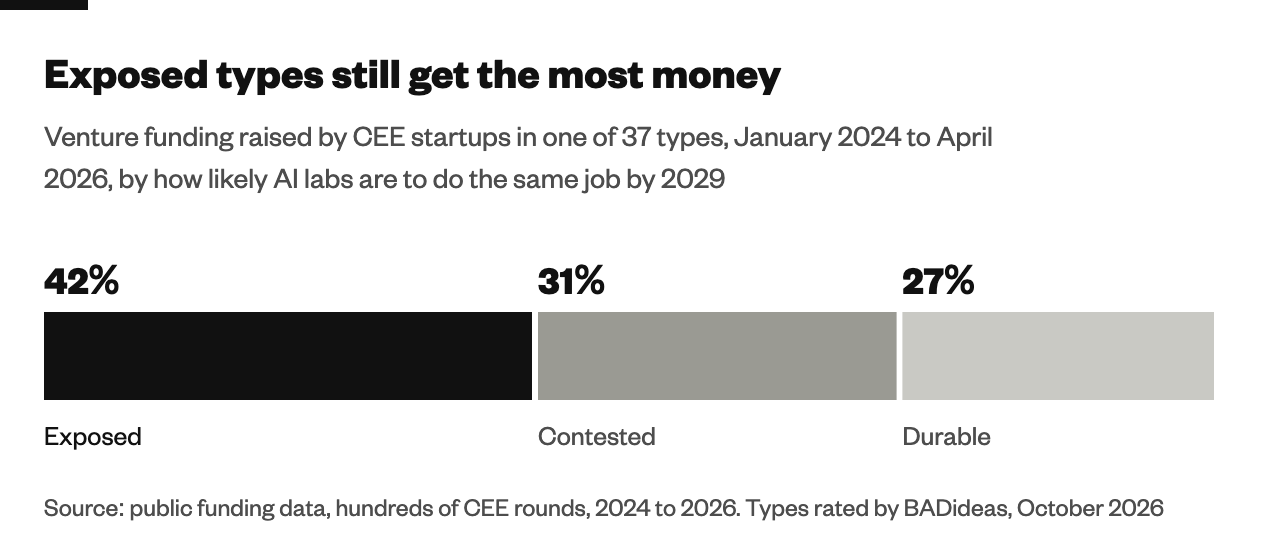
The share moves a lot from one quarter to the next, from 20% to 76%, with no steady trend. Startups with AI at the core of the product sit mostly in exposed types: 63% of those that raised money, against 14% in durable types. Durable types took most of the money in early 2026. Most of it was one round: hotel software company Mews raised $300 million in January.
The founders who come to us look the same. Of the startups that applied to BADideas before October 2025 with no venture money yet, 58% were in an exposed type and 14% in a durable one.
The first round is open, the next one is harder
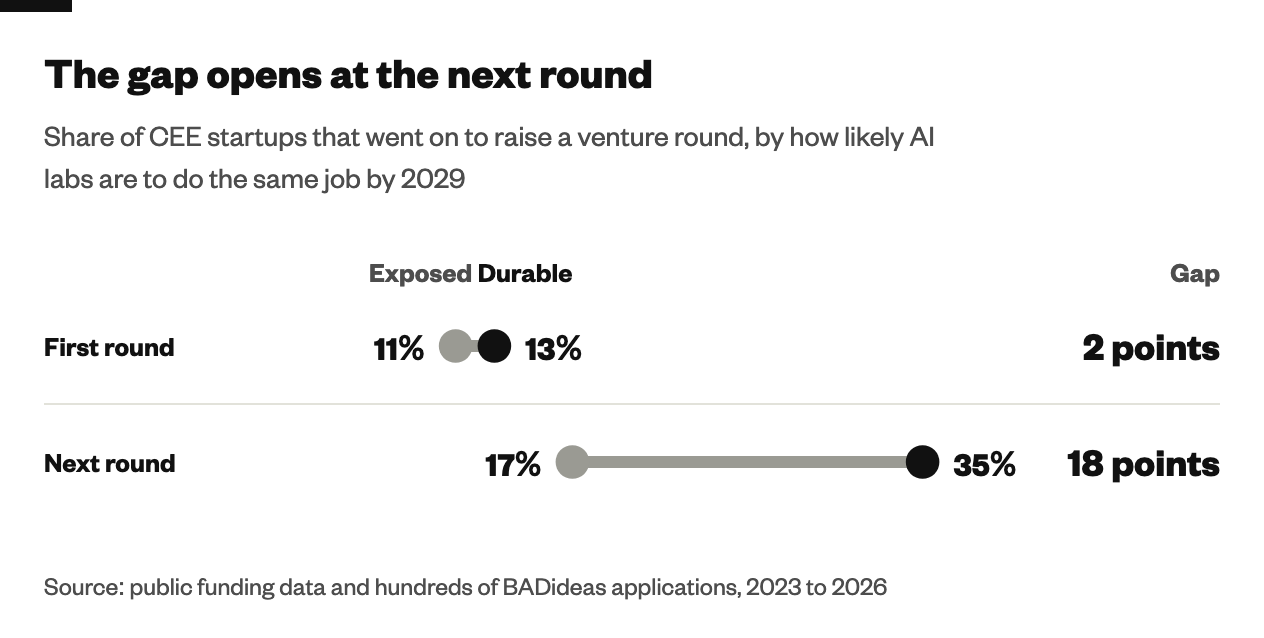
At the first round, the type made little difference. Of the startups that applied to us with no venture money, 11% in exposed types went on to raise a first round, against 13% in durable types. Investors still back AI there. Across everyone who applied to us, with or without venture money, startups in exposed types where AI is the product later raised a venture round 23% of the time. Those where AI is not the product did so 14% of the time.
The picture changes once a startup has raised its seed. Of the startups in the region that raised a first seed round in 2024, 35% of those in durable types had raised again by October 2026. In exposed types it was 17%, half as often. Contested types were close to durable, at 30%.
What to answer before your next round
You do not need to leave an exposed type to raise your first round. But plan now for the question the next investor will ask: what happens to your business when a lab releases your feature?
The answers that hold up are about what you own. You own the whole workflow for a customer, not one task inside it. You work in a field with rules, licences or high stakes. You run something in the physical world. You charge for the result rather than for the tool. Sequoia puts the last one plainly: "if you sell the tool, you're in a race against the model." Distribution can be one more answer, and we wrote about it in why distribution is the new moat.
Write down the one sentence you will give an investor at your next round when they ask what happens to you when a lab releases your feature. Then test it on someone who will argue with you.
How we measured it: we sorted startups from Central and Eastern Europe into 37 types of business and rated each type on how likely AI labs are to do the same job by 2029. We then compared the money each type raised, and how often its startups raised their next round, using public funding data and the applications sent to BADideas. This is a link, not a cause.
Ask a follow up
Send the deck. We read every one.
Yes or no in five business days, with the reason either way.