How long should founder led sales last?
Most startups selling to businesses start with founder led sales. Our investment committee expects it, and asks if founders have sold and can repeat it.
Most startups selling to businesses start with the founders finding, pitching and closing the first customers themselves, and our investment committee expects that early on. What it looks at is whether the founders have really sold and whether someone else could repeat the sale. Founder led sales should last until the founders have closed about their first ten customers and can describe a sale that repeats.
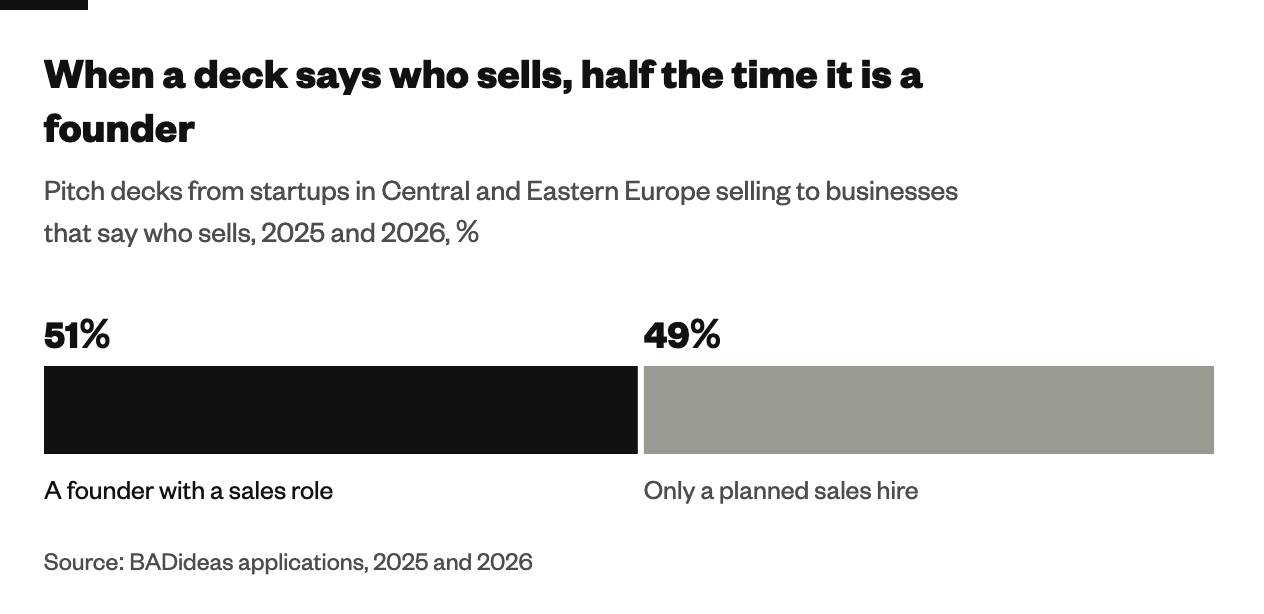
When a deck says who sells, half the time it is a founder
Among the pitch decks that startups from Central and Eastern Europe selling to businesses sent us in 2025 and 2026 and that say who sells, half give the job to a founder with a sales role and half plan to hire someone to sell, at pre seed and at seed alike.
Jason Lemkin of SaaStr puts the handover at the first ten customers, which the founders should close themselves. Hiring a salesperson before that is, in his words, "super risky", because the founders have not yet learned what the new hire should repeat. After that he hires two salespeople at once, so that a bad process can be told apart from a bad hire, and brings in a head of sales only once those two meet their targets. Even then the founders stay involved in sales.
Our committee expects founder led sales that reaches beyond the founders' network
Our committee expects the founders to be the first salespeople, and it sees early deals closed without a sales team as a good sign: the company wins its first customers while spending little, and the founders hear every objection themselves.
Selling is how founders learn who buys, why they buy now, how long a sale takes and what makes a buyer say no. A founder who knows this from their own deals can pass it on to the first salesperson, while a founder who does not leaves that person to work it out alone.
What matters next is whether the sale repeats, and four things in our committee's comments show that it does not yet:
- Customers only from the founders' own network. A network runs out, and sales that rest on it, or on the home market alone, may stop when it does.
- No plan beyond the founder. A founder has only so many hours, so if only the founder sells, the company grows only as fast as the founder can sell.
- Raising money to learn how to sell. Until the sale repeats, money spent on sales is money spent on learning, and the round can run out before the learning is done.
- Nobody who sells. When every founder is technical, there is no one to do the founder led selling, and the company learns little about its buyers.
This is why selling comes up so early with us. How the company will sell is one of the first things we ask on calls with founders, and after we invest it is the problem founders bring to us most often.
A deck should show who sells and what repeats
Show who sells today, and who will sell if every founder is technical. Say how many customers the founders closed themselves and how many of those came from outside your own network. Describe what repeats, meaning the buyer, the reason they buy and how long a sale takes. And say when the first person to sell joins, tied to a milestone such as the tenth customer the founders close.
How we measured it: we read the pitch decks that founders from Central and Eastern Europe selling to businesses sent us in 2025 and 2026, and the comments our investment committee wrote on applications to us. The decks show who is named to sell, not who actually sold. Outside source: Jason Lemkin, SaaStr, "Should a startup founder handle sales themself when first getting started?" and "When you hire your first sales rep, just make sure you hire two" (2013).
Ask a follow up
Send the deck. We read every one.
Yes or no in five business days, with the reason either way.