What SaaStr 2025 taught us about AI sales
Notes from seven SaaStr 2025 talks on how AI changes sales teams, and what founders should do about it.
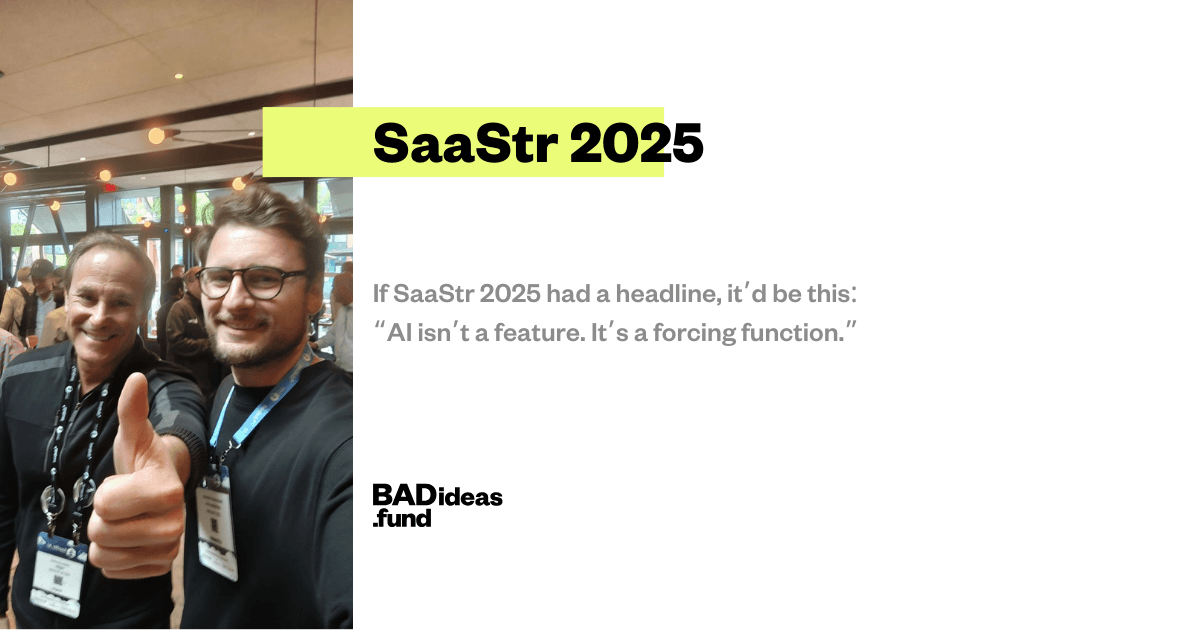
If SaaStr 2025 had a headline, it’d be this: “AI isn’t a feature. It’s a forcing function.” Speakers from OpenAI, HubSpot, Snowflake and Mosaic described rebuilding their teams, sales methods and products around AI.
Here is what we took from seven sessions, for founders and sales teams.
1. Delphi: Context > Content in the AI Era
AI is for building “digital minds” that reflect your team’s actual decision logic.
Key Takeaways:
- Delphi simulated 1M founder conversations. The useful answer always depended on the company's stage, market and customers.
- Vision + gut still matter. Great startups start with intuition, not dashboards.
- AI products need fewer buttons: users type what they want. Small teams can do more.
- Final mantra: “Your people are your IP.” Strategy can be cloned. Context can’t.
2. HubSpot: AI changes how the company is organised
Yamini Rangan made it clear: AI is production-grade at HubSpot. 95% of engineers use tools like Cursor daily.
“Go-to-market now means human + agent collaboration, and seamless handoffs are the new trust currency.”
What’s changing:
- Support: AI resolves up to 80% of tier-one tickets. Knowledge base quality is the #1 driver.
- Engineering: Velocity is up, but so are expectations. Output = business impact.
- Outreach: “Personalized” is dead. If your AI sends a generic email, it’s deleted in 10 seconds.
3. Mosaic.ai: Multimodal, Multilingual, Multi-Variant, By Default
Mosaic is building a video editing agent that handles global, dynamic content in one pass.
Why it matters:
- Edit with natural language (“cut all clips with the guy in glasses”).
- Instant localization via voice cloning + dubbing.
- Branch-based editing: like Git, but for video assets.
4. Snowflake: From Data Warehouse to AI-Native Go-to-Market Engine
Snowflake now lets people ask questions of company data in plain language.
“Customers don’t pay for databases. They pay for insights.”
The go-to-market stack they’re betting on:
- Embedded co-sell motions (e.g., Observe built fully on Snowflake; customers “pay” in credits).
- Usage-based sales comp: reps only win when data flows.
- Sales reps help customers get value from their data as well as close deals.
5. OpenAI: How to Actually Build a Sales Org
Maggie Hott broke it down for founders:
“One exceptional hire is better than three average ones. Every time.”
Top lessons:
- Hire for impact, not enthusiasm. Passion is not a plan.
- Founders must own sales until there’s a repeatable motion.
- Avoid “logo hires.” Ask what they built, not where they worked.
- Hire generalists who work well when little is defined.
6. Kyle Norton: Sales Is Getting an AI Teammate
Note-takers are the past. AI co-sellers are the future:
“It’s not just Digital Kyle. It’s a better one. Because it knows everything.”
What’s coming:
- Agents that sit in Zoom, correct errors, answer questions, and augment reps live.
- CROs who manage human + agent hybrid teams.
- Always-on assistants that understand the product better than your team.
7. Jason Lemkin’s Tough Love Sermon
Lemkin's view: teams still working the way they did in 2021 are already behind.
“Remote + AI ≠ less work. It means 6.5-day weeks with compounding output.”
Hard truths:
- 30–40% of SaaS teams aren’t re-skillable.
- Moats are weaker, momentum wins.
- VCs are chasing $10B+ outcomes. You’ll need 3x more proof, with 70% fewer funders.
🧠 Closing Frameworks for SaaStr 2025
- Refound your company. If you were starting now, what would you build?
- Don’t just adopt AI. Operationalize it.
- Measure outcomes, not engagement.
- Make AI native, not an add-on.
In 2025 the companies that win will be the ones whose teams move fast and actually build with AI.
Send the deck. We read every one.
Yes or no in five business days, with the reason either way.