Should CEE startups sell in the US first?
Selling to consumers, CEE startups that start in the US reach our investment committee twice as often. Selling to businesses, home is no disadvantage.
It depends on who you sell to. We reviewed the companies from Central and Eastern Europe that applied to BADideas: where they are based, where they sell first and where they plan to sell next. For startups selling to consumers, the US made a real difference: those that started there reached our investment committee about twice as often. For startups selling to businesses, starting at home put them at no disadvantage.
Most founders start at home
Almost every founder in the region has heard it: your home market is too small. Most start there anyway. In 2026 so far, 59% of the CEE founders who applied to us named their own country as their first market. Another 21% chose Western Europe or the EU as a whole, and only 8% started in the US.
When our committee reads a company that sells only at home, it often asks one question: can this company grow beyond its home market? It asks it of startups selling to businesses and to consumers alike.
Selling to consumers, the US makes a difference
Of the startups selling to consumers that started in the US, 79% reached our investment committee. Of those that started at home, 40% did.
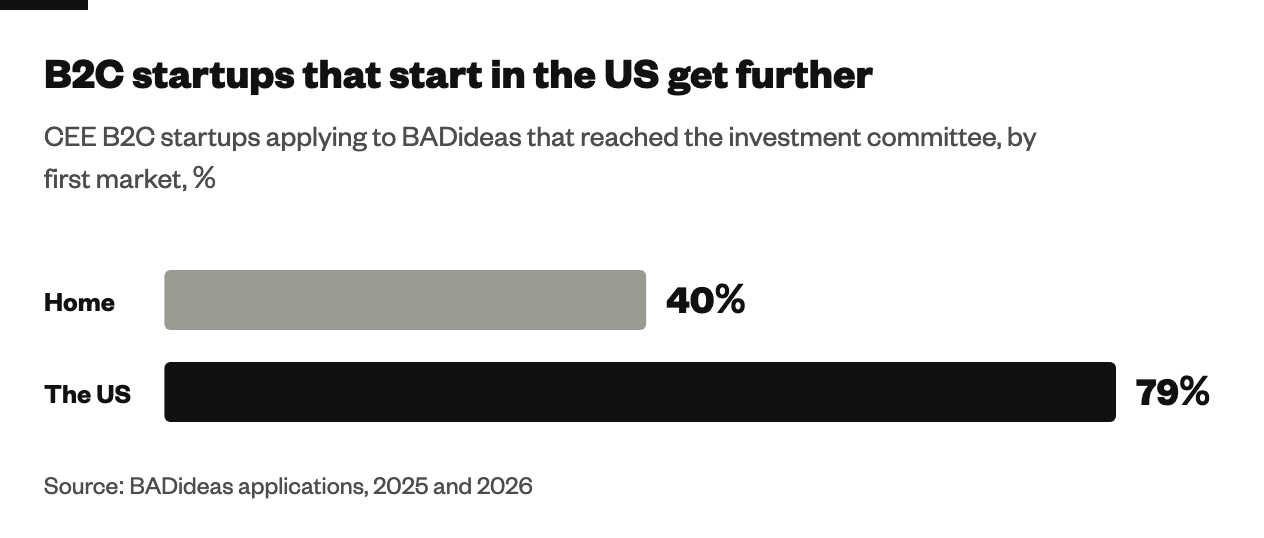
The same gap shows up when we look at different groups of companies. Companies with revenue and companies without it each show a gap of about 40 points. So do first-time founders, and so do founders who had built a company before.
The US is where consumers spend the most. In 2025 it accounted for about a third of the world's spending in mobile apps, nearly $60 billion of $167 billion according to Sensor Tower. That is why our committee looks at whether a startup selling to consumers has a plan for the biggest market. If the product sells only at home, the committee checks whether the same idea already exists in the US and whether the company has a way in. A startup that already sells to consumers in the US has answered that question. Its product already works in the largest market.
Selling to businesses, home is a good place to start
Startups selling to businesses did almost as well from home. Those that started in the US reached our committee 64% of the time, and those that started at home 58% of the time. Before revenue the two groups were level, at 50% and 49%.
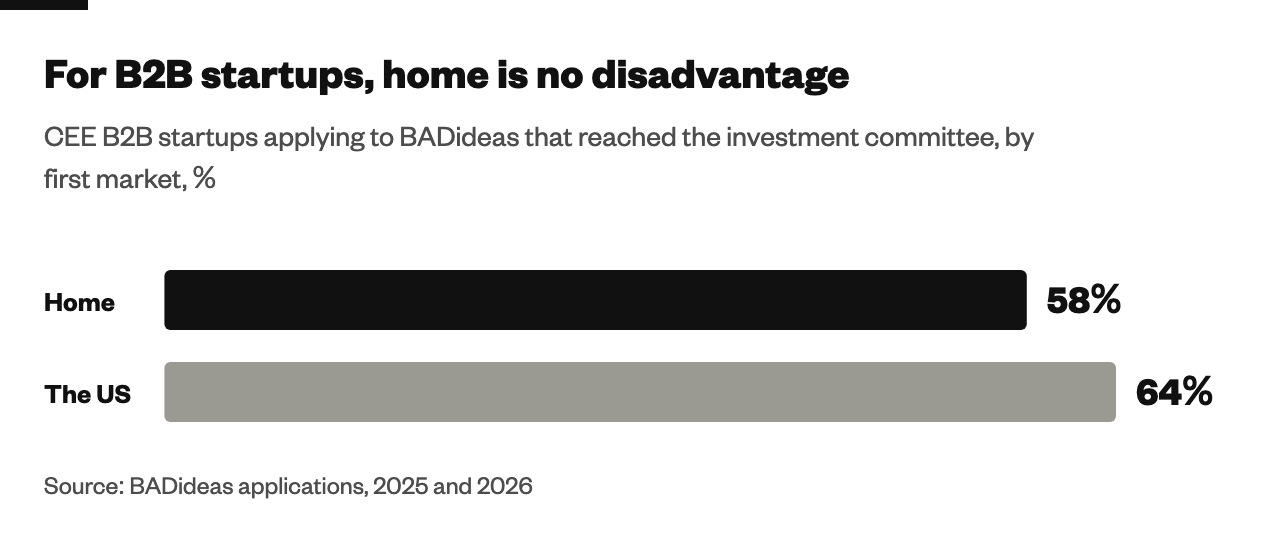
A company selling to businesses can win its first customers close to home and add other countries later. The committee still asks whether the growth will work outside the home country. Here it is a question the founder can answer with evidence, such as a first customer in a second country.
Western Europe does not help either
Many founders take Western Europe as the safe middle step. It is close, it is part of the EU, and it often needs no new company. In our applications it did not help. Startups selling to businesses that started in Western Europe reached our committee 57% of the time, the same as those that stayed at home. Startups selling to consumers did worse there, at 33% against 40% at home.
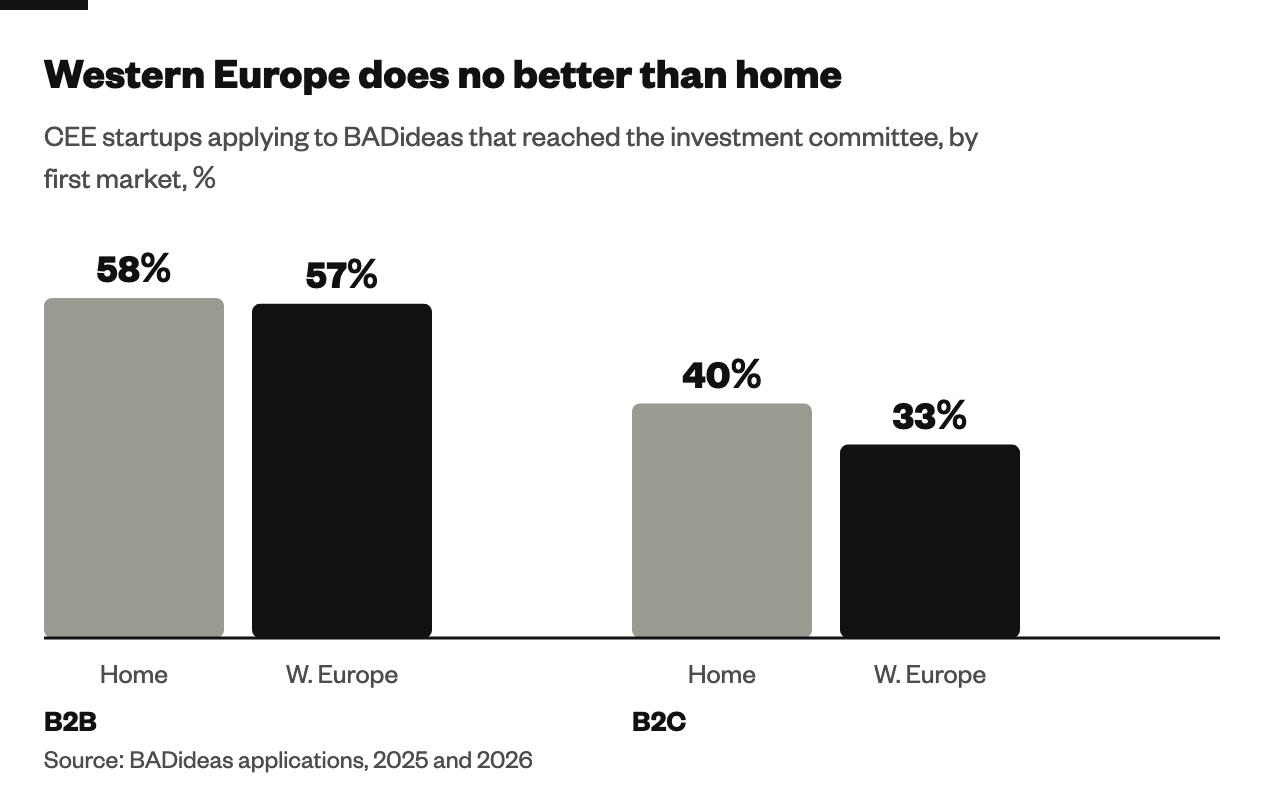
A first market in Germany or the Netherlands shows that a company can sell abroad. It does not yet show that it can reach a market much larger than its own.
Choose your first market by who you sell to
- If you sell to consumers, decide early whether your product can reach the US, and explain how. If your first users can be in the US, start there. If you start at home, show what would stop someone from building the same thing in every other country.
- If you sell to businesses, starting at home is fine. Name your second market, and show one customer or pilot there as early as you can. That answers the question the committee will ask.
- Do not count on Western Europe to make you look bigger. If you start there, be clear about what it gives you that home does not: more buyers, higher prices, or a customer you could not win at home.
This week: write down your first market and your second one. Next to the second, write the one piece of evidence that shows you can sell there.
How we measured it: we compared where each company says it sells first with how far its application to us got. What the committee looks for comes from its notes on these applications. The numbers show a link, not a cause.
Send the deck. We read every one.
Yes or no in five business days, with the reason either way.