Is there a solo founder tax?
Solo founders reach our investment committee 31% of the time against 54% for teams. Once there they score about the same. What that means if you build alone.
We see more solo founder companies applying to us. In 2025 they were 18% of the companies from Central and Eastern Europe that applied to BADideas. In 2026 so far they are 26%. We wanted to know whether building alone costs a founder anything when they raise.
More companies start with one founder
Carta sees the same trend in the US. Many startups use its software to manage their shares. The share of new US companies with a single founder grew from 24% in 2019 to 36% in the first half of 2025. The rate there is higher than ours but the direction is the same. The trend seems to have reached the US earlier than our region.
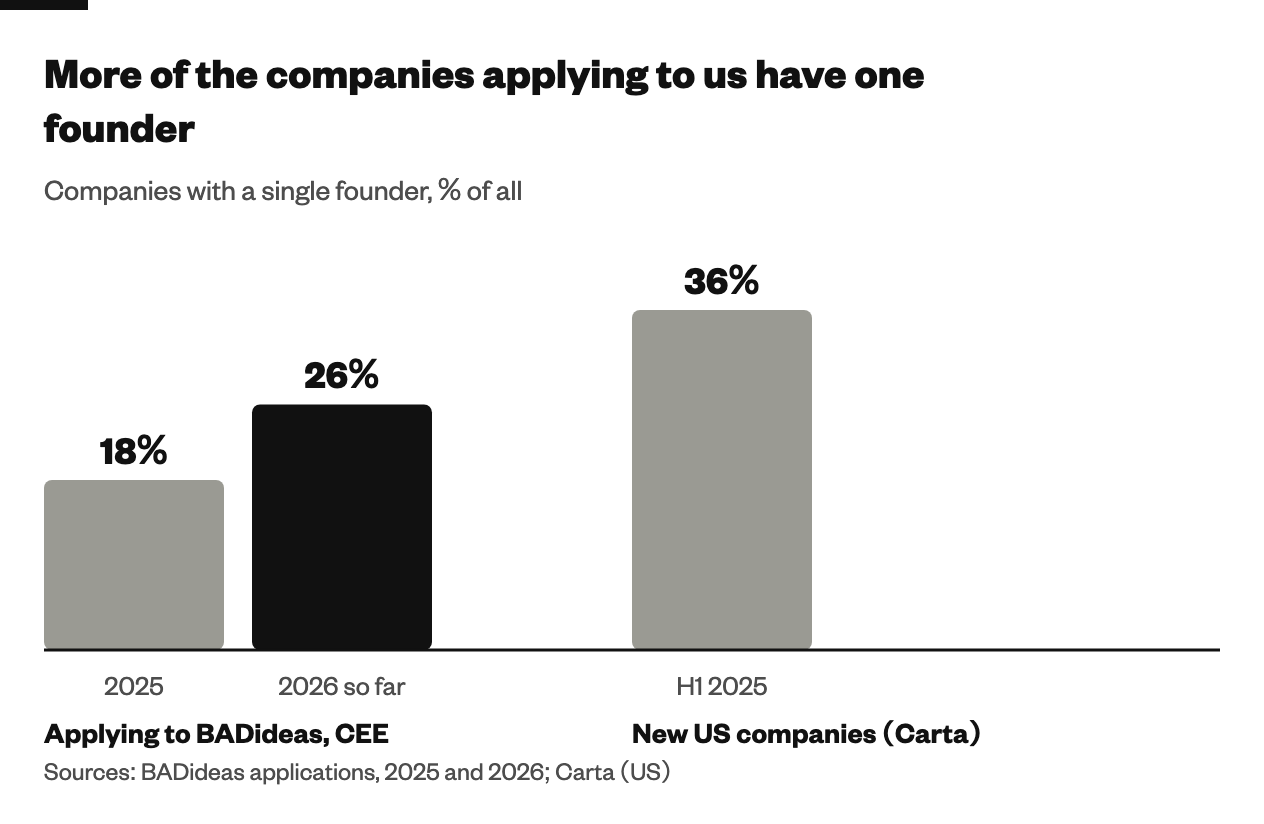
The usual explanation is AI. One person can now do work that used to need two or three. In our applications most of the rise comes from technical founders. They made up 25% of our solo founders in 2025 and 38% in 2026. We expected AI to help people without a technical background build a product without an engineer. We see the reverse more often. Engineers go alone without a business partner and use AI for the sales, marketing and admin work a second founder used to do.
What it means when you apply
Every application passes two gates with us. First we decide whether it goes to our investment committee. Then the committee reads it, scores it and decides whether to meet the founder.
Solo founders are less likely to get past the first gate. Over the last 2 years our committee saw 31% of solo founder companies that applied, compared with 54% of teams. Solo founders also tend to be earlier. Fewer of them have revenue (31% against 42% of teams) and more of them are raising their first round (71% against 52%). But that is not what makes the difference. Even against teams at the same stage solo founders reach our committee less often. So yes, there is a solo founder tax, and with us it is paid at the first gate.
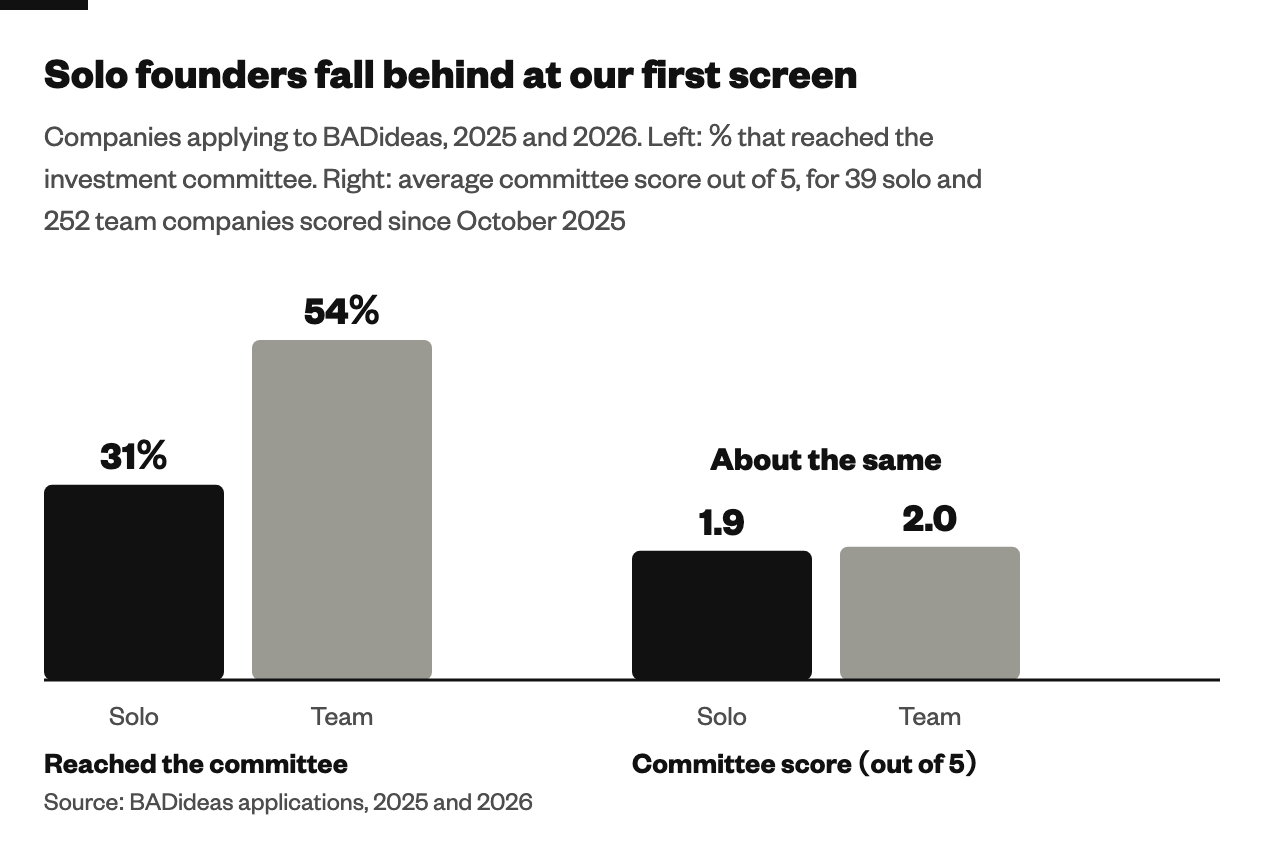
At the second gate the gap has closed. Solo founder companies used to score lower than teams with our committee. Since late last year the scores are almost the same. Once the committee reads your application it judges the company and the number of founders makes little difference to the score.
The wider market has not caught up. In Carta's data solo founders started 30% of new US companies in 2024 but received 15% of the money raised in funding rounds that year.
The rise of the solo founder is real and we expect it to continue. It does not remove the need to show that you can do the work that used to take several people: build the product, sell it and hire when it is time. But solo founders have done worse with investors in the past, including with us. We have decided to change that. At our first gate we will judge how far a company has come and what one person with today's tools can actually do. The number of founders will not count against you. Once you reach our committee, that is already how it works.
Related questions
Send the deck. We read every one.
Yes or no in five business days, with the reason either way.