What happens on the first investor call
Founders pitch the problem, the team and the market. On a first call we ask about the product and how you win customers, and push back most on whether someone could copy you.
Most founders pitch the same three things: the problem, the team and the market. Once the pitch is over, our questions go somewhere else. We ask most about the product, and then about how the company will win customers. What we push back on most is whether someone else could do the same thing, and only about one deck in eight answers it. This is what we see in our calls with founders.
Founders pitch the problem, the team and the market
Pitch decks look much alike. Nearly every one has a slide on the problem (96%), on the team (92%) and on the market (87%).
The call follows the same pattern. Half of founders start by telling us about their own background, and about one in four starts with the product. We usually let the founder talk for a good while before we ask our first question about the business.
After the pitch, we ask about the product and customers
On a typical first call we get through about ten questions. Some of them go back over what the deck already covers: the problem and the size of the market each come up in one call in five, and the team in about one call in three. The two topics we raise in the most calls, though, are the product and how the company will win customers.
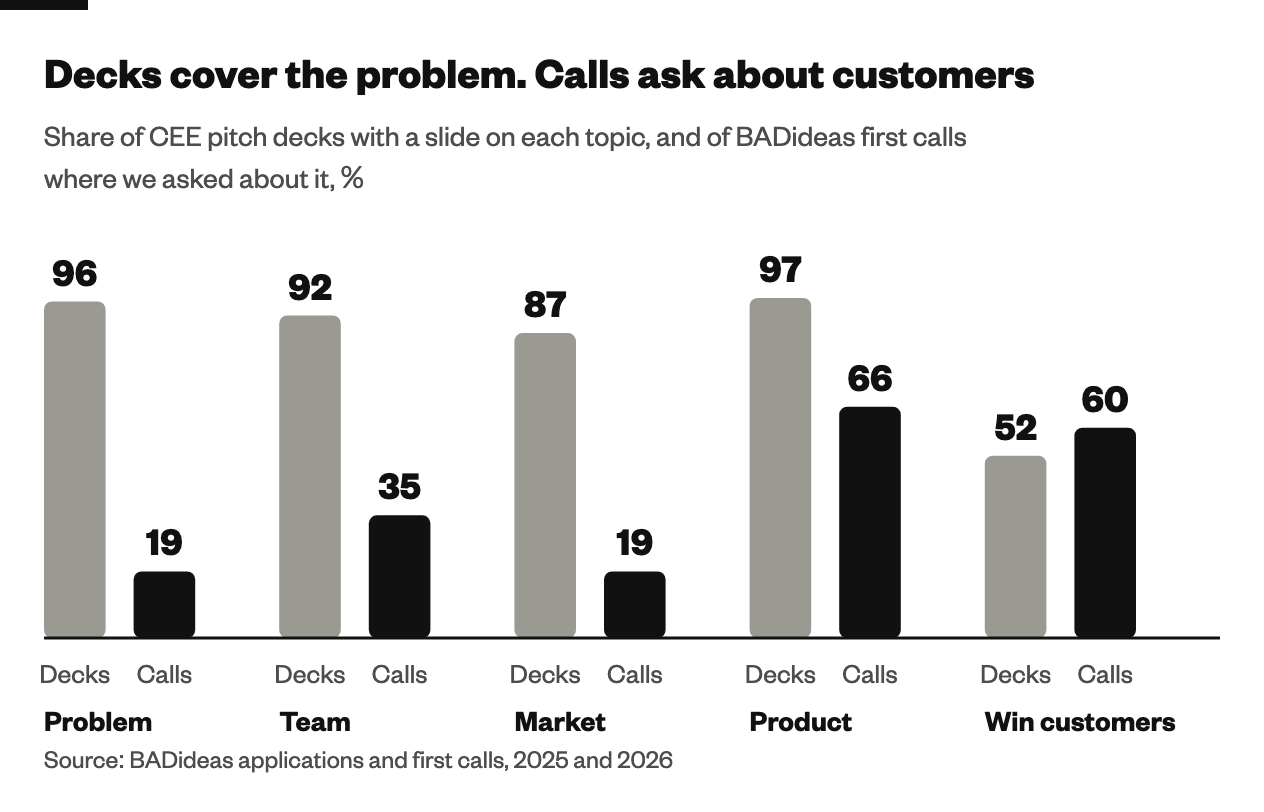
We ask about the product in two calls in three. How the company finds and wins its customers comes up in three calls in five. This is where the deck often falls short, because only half of decks have a slide on how the company will sell.
What we challenge most: could someone else do the same?
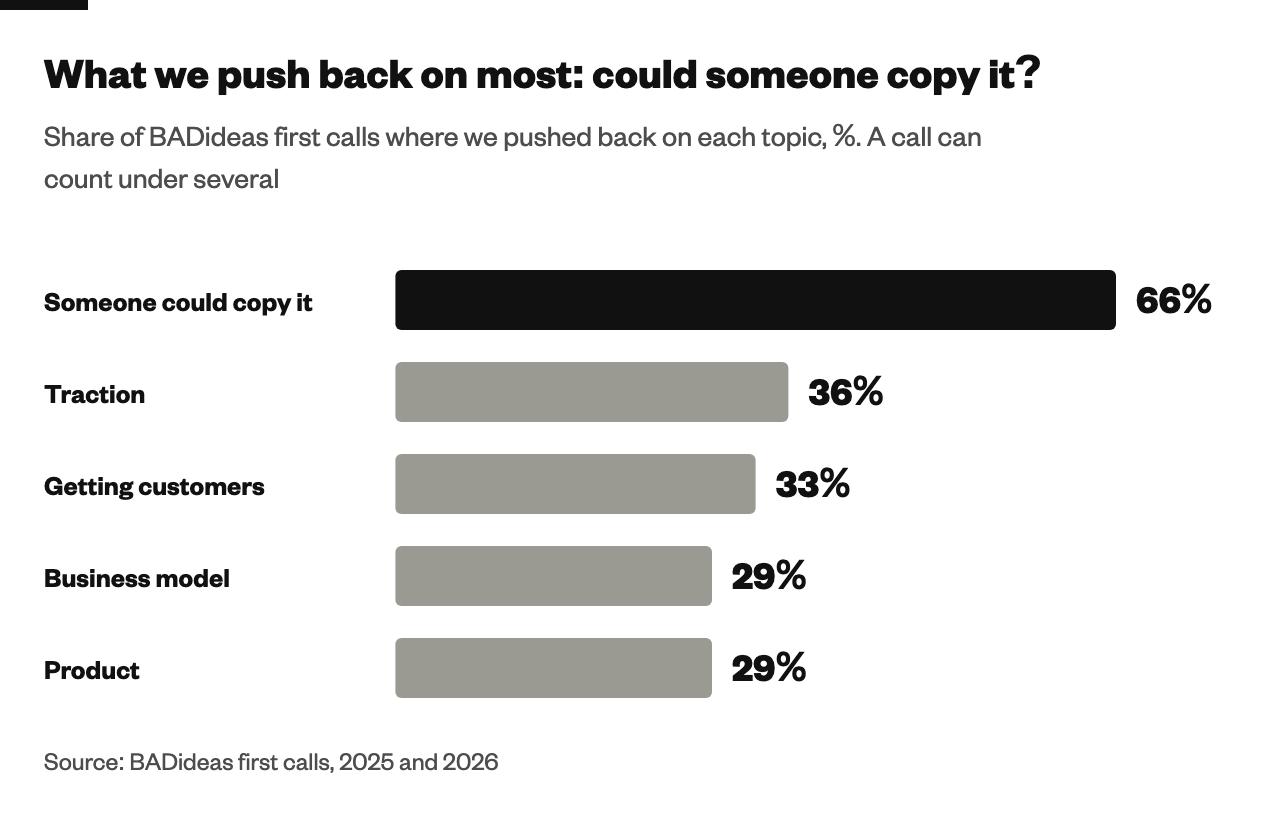
We are upfront about what we are not yet convinced of, and we say so on the call. What we challenge founders on most is whether someone else could do what the startup does. That comes up in two first calls in three. Next comes traction, in about one call in three.
That someone else is usually one of three. It might be a competitor already selling something close. It might be a large company that adds the same thing as a feature for its own customers. Or it might be an AI model that keeps improving until the product is no longer needed.
Decks rarely answer this. Three in four have a slide on competitors, but only about one in eight explains why someone else could not simply build the same thing. We read 30 decks that use words like "competitive advantage", and 17 of them put those words above a table of features or a customer benefit. A table of features shows what the product does today. It does not show why a larger company could not build it next year.
Evidence convinces us six times as often as a plan
What gives us confidence is evidence: a number, a customer or a result. When founders met one of our challenges with evidence, we were convinced on the call 39% of the time: happy with the answer and ready to move on. When they answered with a plan for what they will do, we were convinced only 6% of the time.
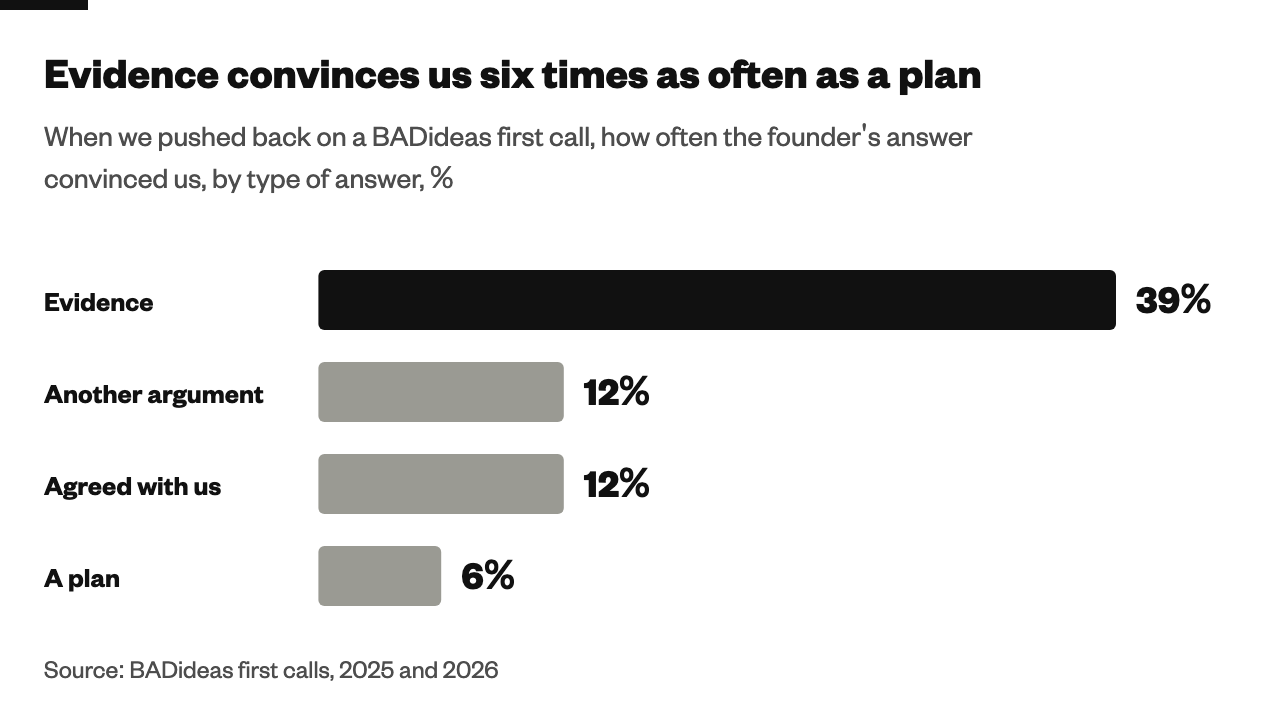
You might expect that stronger companies simply have better evidence. If so, the gap would close when we compare similar companies, and it does not. Before revenue, evidence convinced us 31% of the time and a plan 3%. Even within the same call, when a founder answered some challenges with evidence and others with a plan, evidence convinced us 42% of the time and the plan 5%.
Being copied was the hardest challenge to answer. In two answers in three, founders moved on to a different point: we are faster, we know the customer better, the category is new. Those answers convinced us 6% of the time. The founders who did convince us pointed to something concrete, such as data that others cannot get another way, customers that larger companies do not serve, or owning the customer's whole workflow.
Prepare the two answers many decks leave out
Your deck probably already covers the problem, the team and the market. Before a first call, prepare the two answers it most likely leaves out. The first is how you win customers: who buys, how you reach them and what it costs. The second is why someone else could not do the same. Name the competitor, the large company or the AI model most likely to try.
This week, write down the one piece of evidence that shows someone could not simply copy you: a number, a customer or a result. If you cannot find one, that is the question to work on before your next call.
How we measured it: we read the pitch decks that founders from Central and Eastern Europe sent us in 2025 and 2026. We then read our own first calls with founders from the same years, for the questions we asked, what we challenged and how founders answered. The decks come from everyone who applied, while the calls come only from founders who reached a first call with us. Other investors may weigh these questions differently.
Ask a follow up
Send the deck. We read every one.
Yes or no in five business days, with the reason either way.